
The macula and the retina
The retina lines the back of the eye and converts light into the signals your brain reads as vision. At its centre sits the macula — the small area responsible for detailed central vision, the part of your sight you rely on for reading, recognising faces and driving.
Because both lie deep inside the eye, problems there are usually painless, and the first sign is a change in what you can see. Our team provides both medical and surgical care for this part of the eye.
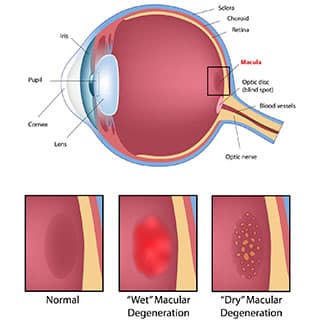
Macular degeneration (AMD)
Age-related macular degeneration is the most common macular condition we see. It affects people aged 50 and above, causing distortion or loss of central vision — the part of your vision you need for activities like reading and driving. Risk factors include increasing age, smoking, and a family history of the condition.
Two types of AMD
Dry AMD
The most common form (around 80–90% of cases), caused by degenerative changes at the macula. It develops gradually, with slow progression of vision change. There is currently no treatment to restore vision lost as a result of dry AMD.
Wet AMD
Develops more rapidly, caused by abnormal blood vessels growing at the macula. Prompt treatment is essential to preserve vision.
How AMD is managed
For dry AMD, care focuses on prevention — nutritional supplements, dietary changes, lifestyle adjustments, and regular monitoring at home using an Amsler grid.
For wet AMD, several treatment options are available, but prompt intervention is essential for them to be effective.
Other conditions we treat
Our team manages the full range of complex conditions affecting the back of the eye, with both medical and surgical care, including:
- Retinal detachment
- Macular holes
- Epiretinal membranes
- Diabetic retinopathy and diabetic macular oedema
- Retinal vascular occlusions
- Floaters and vitreous changes
Surgery and treatment
Treatment depends on the condition and may include intravitreal injections, laser therapy, or vitreoretinal surgery such as vitrectomy to repair the retina. Your surgeon will explain which approach is right for your eye and what to expect through recovery.
Dr Monika Pradhan leads our medical and surgical retina service — one of only three female vitreoretinal surgeons in New Zealand.